
When Banking Failures Are Decision System Failures
Applying business dynamics to institutional resilience.
A different way of seeing
One of the things I appreciated most about MIT Sloan Executive Education's Business Dynamics course was that the learning was not confined to classroom theory. The emphasis was on applied context and action learning, and the course carried a powerful intellectual lineage.
Jay Forrester founded the field of System Dynamics at MIT. John Sterman carried Forrester's ideas deeply into management education and framed dynamic complexity not as an abstract modeling challenge but as a leadership challenge. Nelson Repenning added another layer: how organizations actually behave under pressure, why teams fall into familiar operating traps, and why better intentions do not automatically produce better systems.
The course introduced a way of seeing organizations not as collections of isolated decisions, but as dynamic systems shaped by feedback loops, delays, incentives, constraints, and consequences over time. That perspective has stayed with me, especially in my work across banking, treasury, governance, and institutional strategy.
Counterintuitive behavior
I was especially influenced by Forrester's classic essay, Counterintuitive Behavior of Social Systems. His central insight remains deeply relevant: social systems often behave in ways that defeat intuition. Well-intended actions produce unintended consequences. Policies that appear sensible in the short term can weaken the system over the long term. Interventions aimed at symptoms can reinforce the very structure producing those symptoms.
That lesson applies directly to banking.
The incomplete post-mortem
Most banking failures are explained after the fact in technical terms: capital, liquidity, credit quality, interest rate risk, deposit concentration, asset-liability mismatch, or risk management failures. Those explanations are usually correct. But they are often incomplete.
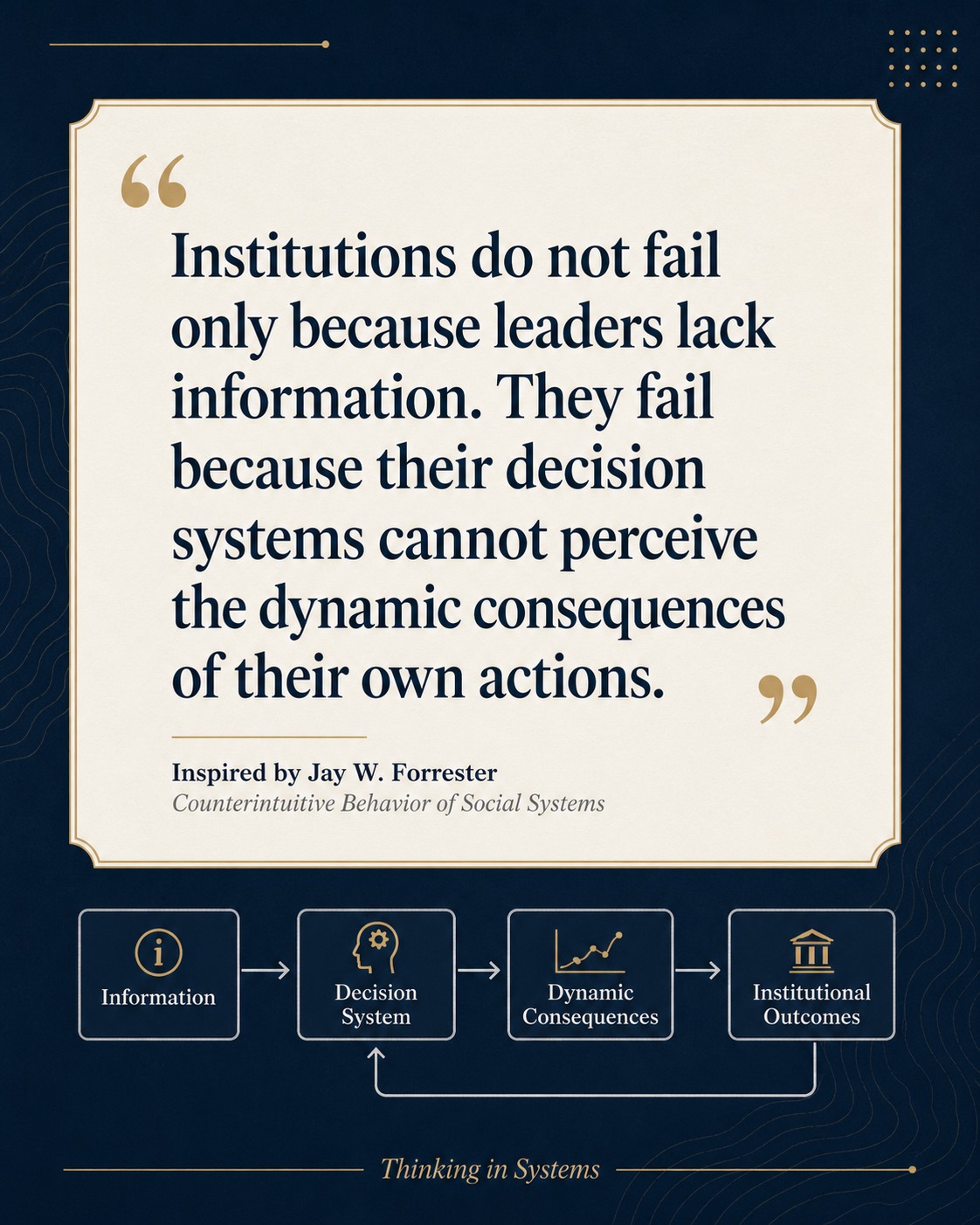
A systems lens asks a deeper question. Was the institution's decision system capable of seeing how its own actions would compound across time?
Silicon Valley Bank as a systems failure
Take Silicon Valley Bank as one example. The conventional explanation is that the bank took too much concentrated interest rate and liquidity risk. That is true, but it is not the deepest truth available. All banks have risk. The deeper issue was that the institution's decision system was not structurally capable of seeing consequences across time.
It did not fully account for how rapid growth, concentrated deposits, securities portfolio decisions, unrealized losses, customer behavior, market confidence, and liquidity demands could interact as one dynamic system. Today's earnings strategy can become tomorrow's capital constraint. Today's balance sheet optimization can become tomorrow's liquidity trap. Today's benign assumption can become tomorrow's run dynamic.
This is the counterintuitive behavior Forrester warned about. Complex systems do not fail in straight lines. They fail through feedback loops, delays, reinforcing pressures, and decisions that appear rational locally while becoming dangerous systemically.
What this asks of leaders
For banking leaders, the implications are practical. More information is not enough. More dashboards and more reports are not enough either. Those tools matter, but they do not automatically create institutional foresight. The real question is whether the institution has a decision system capable of converting information into governed judgment over time.
Four questions test whether that system exists:
- Can it distinguish symptoms from causes?
- Can it identify feedback loops before they accelerate?
- Can it test assumptions before they become embedded in strategy?
- Can it recognize when today's profitable action is creating tomorrow's liquidity, capital, or reputation constraint?
That is why systems thinking is so valuable for executives and boards. It forces leaders to move beyond static analysis and ask how decisions behave dynamically inside the institution.
The close
Banking is not only a financial system. It is a dynamic decision system. And durable institutions are not built on information alone. They are built on decision systems capable of understanding how action becomes consequence.
That is one of the enduring lessons I took from MIT Sloan Executive Education's Business Dynamics course. It remains one of the most practical frameworks I have encountered for understanding institutional resilience.
Read the Founder Thesis
The full Calibra point of view: why institutions drift, why AI amplifies architecture, and what capital architecture looks like in practice.